The Saudi Ardah
The Saudi Ardah (or Al-Ardah Al-Najdiyah) is a traditional Saudi sword dance performed at celebrations, holidays, and official state events. It serves as an iconic cultural symbol used to welcome visiting heads of state and international dignitaries.
The art of the Saudi Ardah
Previously, the Ardah was performed as an announcement and preparation for war, serving as a motivation for courage and a reminder of strength and bravery, and as a renewal of loyalty to the leader and a pledge of support. With the establishment of security in Saudi Arabia, the Ardah has transformed into a kinetic performance expressing joy and is held on happy occasions.
It is a masculine dance that relies on solemn collective movement, simulating ancient battles with the Muhawreb, knights, drums, flags, swords, and enthusiastic poetry, originally associated with the declaration of war. Over the ages, it has undergone some modifications and developments to appear in its current form.
The Saudi Ardah begins with the Hawrabah, which represents the opening and first call of the Ardah, chanted by a performer with a robust voice called the Muhawreb, starting from the musical maqam of al-Nawa. This is followed by the phase of Takhmir (large drums) and Tathlith (small drums), leading to al-Zamiya phase, which represents the conclusion of the Ardah with the recitation of the phrase Tahta Bayraq Sayidi Sama’an Wa Ta'a (Under the banner of my King, we heard and we obeyed). More than one line can perform the Saudi Ardah simultaneously and in any direction.
The history of the Saudi Ardah
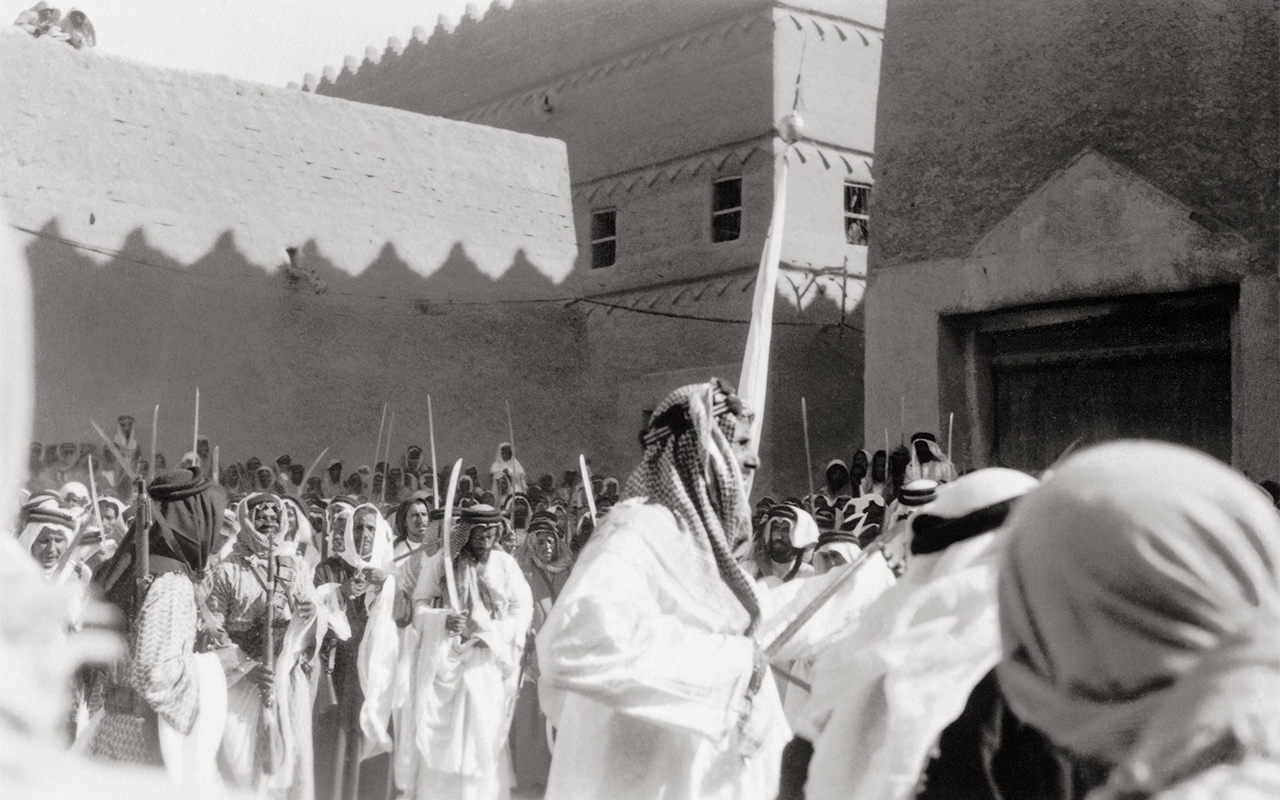
The earliest recorded mention of the Ardah dance dates to 1764, when Ibn Ghannam described Imam Abdulaziz Bin Mohammed Bin Saud leading his army outside Diriyah's walls and performing the Ardah facing the enemy.
The Ardah in the reign of King Abdulaziz
The Ardah was known as a war dance, where the Muhawreb would recite two or three verses that rouse courage, as a declaration of war and its first signal. It was present during the era of the Founding King Abdulaziz Bin Abdulrahman Al Saud in the wars and battles he fought on various fronts. The verses of the Ardah were expressive and truthfully reflective of the reality they were living in, ranging from pride and enthusiasm to displaying strength and endurance, showcasing equipment and armament, and either declaring war or celebrating a victory.
It is narrated that when King Abdulaziz intended to confront an opponent, he would designate a place to gather the warriors who would come chanting the Ardah songs as an announcement of their readiness and preparedness. He would lead them to the rhythm of drums and chants, carrying the banner, proudly boasting and exulting in his soldiers. Additionally, the Ardah was performed during times of victory and on festive occasions as a celebration of glory. History shows King Abdulaziz participating with his people in performing the Ardah on their occasions.
The Ardah in the reign of King Saud
The Ardah continued in the era of King Saud Bin Abdulaziz Al Saud in the same style, being performed in official celebrations and joyful occasions. King Saud participated in performing the Ardah since the time of his father. However, he added speed and agility to its performance.
It is noted that he gave it special attention, encouraging its practice and celebration as it immortalizes the memory of the founding of Saudi Arabia, the memory of the founder, and the struggles he and his men endured to bring Saudi Arabia and its people to their current state.
The Ardah in the reign of King Faisal
The Ardah continued during the reign of King Faisal Bin Abdulaziz Al Saud, being performed in celebrations of festivals, occasions, and visits of delegations and state leaders. King Faisal was among the prominent performers of the Ardah. His performance was characterized by his steady and poised movements, proudly showcasing his stature and torso in his slow swaying to the left and right.
During his reign, the traditions of the Ardah were meticulously preserved, such as chanting the Ardah songs, many of which he knew by heart. He also performed it during visits of state leaders, involving them in the performance and offering them his sword to execute some of the Ardah movements he taught them. They appreciated participating in this cultural heritage and took commemorative photos during its performance.
The Ardah in the reign of King Khalid
King Khalid Bin Abdulaziz Al Saud continued the tradition of King Abdulaziz and his brothers by celebrating with the Saudi Ardah during festivals and special occasions.
He maintained strict adherence to its traditional techniques, honoring the values and symbolism behind the performance.
Most historical images capture him participating in the Ardah alongside his brother, King Faisal.
The Ardah in the reign of King Fahd
King Fahd Bin Abdulaziz Al Saud participated in the Ardah from an early age, alongside his brothers, the kings and princes.
He wore the traditional Ardah attire in some of the performances he took part in.
The Ardah in the reign of King Abdullah
King Abdullah Bin Abdulaziz Al Saud passionately preserved and modernized the Ardah, establishing its official rules, designating a special day for it, and using it to honor Saudi identity and history.
He expanded and unified the performance across all regions of Saudi Arabia, transforming it from a regional practice (Al-Ardah Al-Najdiyah) into the national Saudi Ardah.
Al-Ardah in the reign of King Salman
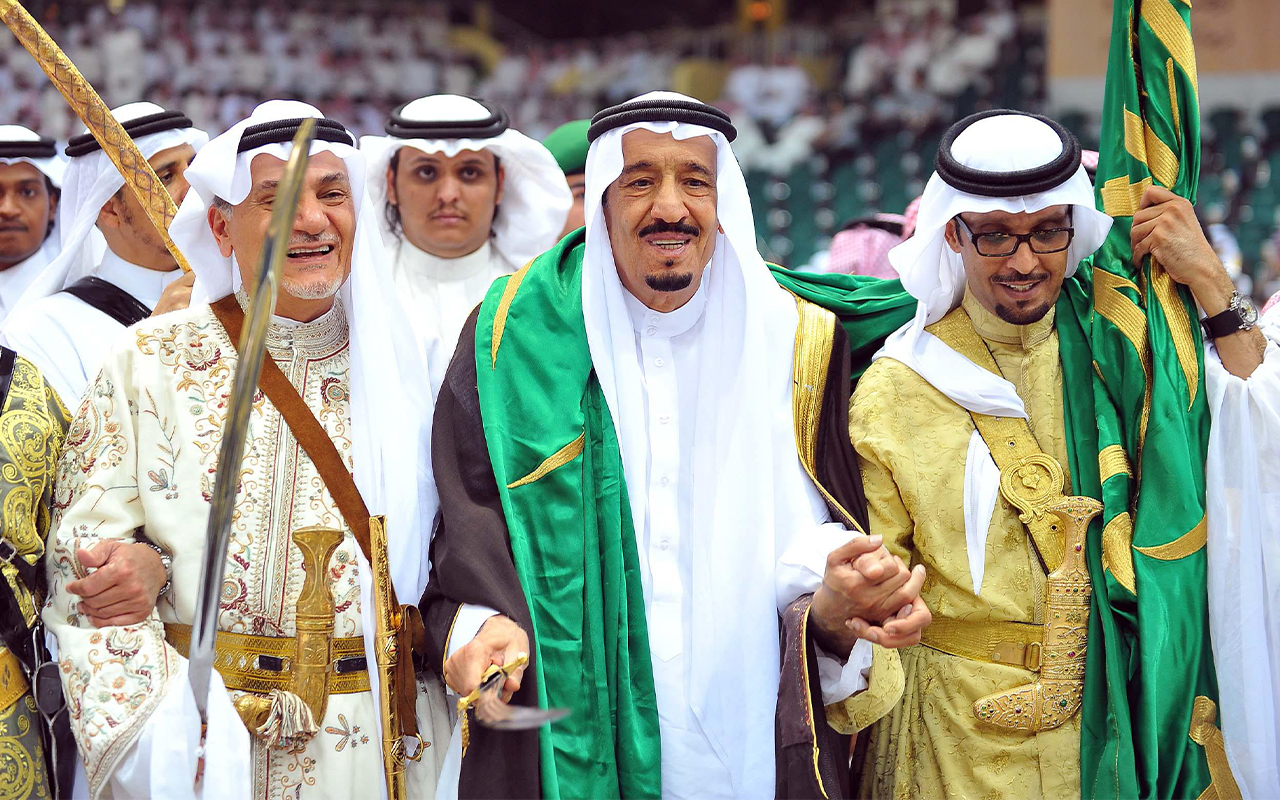
The Ardah received special attention from the Custodian of the Two Holy Mosques, King Salman Bin Abdulaziz Al Saud since he was the Prince of the Riyadh Province. He was keen on attending all the celebrations of the Saudi Ardah, participating alongside his brothers, the kings and princes, and chanting its songs.
Reflecting his interest, he issued a decision while presiding over the forty-eighth meeting of the Board of Directors of the King Abdulaziz Foundation (Darah), which stipulated the establishment of the National Center for Saudi Ardah. He continued to participate in the performance of the Ardah, particularly in the (the thirty-second Janadriyah) National Festival for Heritage and Culture, where the Ardah is featured as a special segment for Saudi Arabia's distinguished guests, including kings, presidents, and ambassadors.
The Material Elements in the Saudi Ardah
Costumes of the Saudi Ardah
The traditional Ardah costume requires performers to wear standard Saudi attire—the Thobe, Ghutra, and Uqqal—along with specialized robes like the Sayah or Daqlah, while drummers wear the Farmaliah.
To preserve this cultural heritage, the Saudi National Center enforces strict guidelines that require performers to adhere to these traditional garments and reflect their regional variety.
The costume of Murowdin
The Murowdin is a loose-fitting garment with wide sleeves that covers the entire body over the traditional Saudi Thobe.
It is designed to be worn alongside traditional weapons, including a sword and a dagger.
The outfit is completed with a specialized belt used to carry ammunition.
Daqlah
This is a long, embroidered coat characterized by straight collars and six upper buttons. It is worn over the Murowdin. The fabric is heavy winter cashmere, and it is often open from the front and tied with two threads.
Farmliah
Known as al-Damer, it is a short coat with long sleeves, made of wool and embroidered with gold threads. It was part of the princes' attire before being designated for the drummers in the Ardah. It comes in several colors, such as green, red, and black.
Sayah
A garment made of light white fabric, it is subtly embroidered and barely visible. It is commonly worn by the companions of the kings in the royal court outside of the Ardah.
Zabon
This is a currently rare costume. It resembles the Daqlah in design but is thinner. It is also embroidered with gold threads and has two gimp buttons at the top near the neck, which are used for fastening.
Jukha
Known as al-Mahoud, it is made of broadcloth, comes in several colors like red and green, and is embroidered with gold threads. It is often worn by knights and dignitaries.
Weapons of the Saudi Ardah
Originally a war dance, the Saudi Ardah was performed to boost morale and demonstrate strength, endurance, and military readiness.
Weapons such as the sword, dagger, pistol, and rifle remain central elements of the performance, symbolizing power and heritage:
The sword
The sword is the main weapon of the Ardah, featuring a light, sharp blade, a hilt usually decorated with gold or silver, and a colorful scabbard used when swords are scarce.
Famous for using Indian and Damascene blades, the sword is held by its hilt and sheathed safely during the performance.
The dagger
The dagger is a short, curved weapon worn as a costume accessory on a decorated belt (al-Mujanad al-Muzahhab) rather than used for performance, and it is known by names such as al-Qadeemi, al-Shalqa, al-Shibriya, and al-Janbiya.
To ensure safety, the Saudi National Center for Ardah requires that both daggers and swords match historical designs but remain unsharpened during performances.
Al-Fard
This is a compact, eight mm caliber pistol called al-Fard, secured on a leather belt. It is considered an accessory of the Ardah costume and is used in the physical performance when it is discharged into the air. The Saudi National Center for Ardah stipulates that firearms must be unloaded, devoid of any ammunition.
The rifle
The rifle is used during the physical performance of the Ardah, pointed toward the sky or ground and fired, with notable types including al-Fateel, al-Muqma', al-Musba', al-Jift, al-Mashkok, Umm Khams Talqat, and the Enfield.
The rhythmic sound of the Saudi Ardah
Saudi Ardah poems
The Ardah relies on poetic lyrics that describe clouds, mounts, or calls, denigrate opponents, and praise bravery, with each poem lasting up to ten verses using the poet's choice of meters and rhythms.
These poems document past history, are passed down through generations, and feature prominent ancient and modern poets like Mohammed al-Aouni, Fahid Bin Duhayyim, and Abdulrahman al-Safyan.
Sequential vocal performance
The Ardah begins with the Hawrabah, a two-to-three verse recited call by a strong voice to signal alignment, followed by the poet reciting a Nabati poem of up to ten verses that two lines of performers repeat in alternation while Mawazir, Takhmir, and Tathlith drums join in sequence.
As the rhythm speeds up, performers gather around the leader with raised swords, chanting songs of loyalty and support to conclude the performance.
Drum rhythms in the Saudi Ardah
Drums are known as rhythmic musical instruments made from the wood of palm tree trunks, shaped into a frame that measures two to four cm thick, seventy-five cm in diameter, and fifteen cm wide. The skin of a camel, after being tanned and devoid of hair, is stretched wet over both sides of the drum. Its edges are tied using interlaced leather straps.
The wooden frame is then drilled to insert a handle, which in turn is attached to a sturdy leather belt, allowing the drummer to carry the drum on their shoulder. The drums used in the Saudi Ardah are divided into two types: large drums called Takhmir drums and small drums called Tathlith drums. Each type has a different number of beats and distinct timing for striking.
During the performance of the Ardah, the Takhamir drums are hung around the shoulder using a leather belt, holding the handle in the left hand while striking the instrument with a thick stick in the right hand. This stick, about thirty cm long, is made of bamboo and curved at its other end.
The drum is struck from the curved side, while slightly tilting the drum to the left. Simultaneously, the drummer moves his body to the right and left, then in the opposite direction, lifting the foot that is on the opposing side and slightly bending his knees downwards. The number of Takhmir drummers ranges from six to eight drummers. The greater the number, the more thunderous and majestic the Ardah becomes, as the multitude enhances the value and enthusiasm of the dancers.
The player of the Tathlith drums performs dance movements while striking the drums. They raise the left hand holding the drum and then lower it down and forward, with two consecutive jumps followed by squatting and then standing again. Therefore, the small drums must be lightweight for easy control.
A piece of cloth is wrapped around the handle to prevent injury to the drummer's hand, and the frame is decorated with some tassels, similar to the large drums. These are colloquially called al-Raith or al-Danadish, as they carry a lot of al-Danadish and aesthetic decorations to create an aesthetic look when the drums are moved.
The large drums are struck with a single beat called Tafreda, while the small drums are struck twice and are called Muthaniyah. This is the reason they are named Tathlith drums because their two beats triple (in Arabic Tuthallith) the beat of the large drum. In the Saudi Ardah, a primary rhythmic pattern of binary units is used. The strong beats in the rhythm, known as Dum, are produced by striking the center of the drum with a bamboo stick.
The Tak, which is played in the same spot, involves muting the leather surface of the drum with the same stick. The large drums are responsible for playing the basic unit of this rhythm. The controls of the Saudi National Center for Ardah stipulate that the drums must have two sides and that tambourines or any other instruments are not acceptable. The drums should be decorated with traditional ornaments.
Melodies of the Saudi Ardah
No melodic instruments are used in the Saudi Ardah, and it is limited to vocal performances of poems accompanied by drumbeats. Typically, Saudi Ardah poets use a simple melodic structure and maqams for the Ardah poem, often not extending beyond the pentatonic scale (typically using the first tetrachord), similar to many other folk songs worldwide that are known for their simplicity.
The melody in Saudi Ardah does not exceed the fourth degree in the maqam used for Ardah, and sometimes the melody descends below the tonic degree by a semitone or two. If the maqam used is Sika, which is the most common and widely used maqam in Ardah melodies, the melodic line does not extend beyond the Husseini note (the fourth degree) and sometimes descends to the Rasd or Douka degree.
The limited melodic range in Saudi Ardah can be attributed to its complete reliance on the style of poetic recitation. The Ardah's origin as a war dance means that it requires strong dramatic recitation without elaborate musical embellishments.
This style is commonly followed worldwide when composing national epics, powerful segments in classical musical compositions, and choral forms like opera and operetta.
Maqams of Saudi Ardah
The melody of most of the poems in Saudi Ardah relies on a musical maqam called Sika, which is an eastern maqam. The emphasis in Sika maqam is on the Sika note within the diatonic. Towards the end of the Ardah performance, there is an increase in rhythmic patterns as the performers move towards the leader while raising their swords.
This maqam is distinctive to Arabic music and sets it apart from other musical traditions. It features intervals of three-quarter tone, which are unique to Arabic music and are particularly evident in maqams derived from the Sika degree. These intervals are a common characteristic in the melodies of Saudi Ardah, as well as in other maqams, such as Huzam, al-Maya, Rahat al-Arwah, 'Iraq, and Shu'ar (Musta'ar).
The Saudi Ardah flag
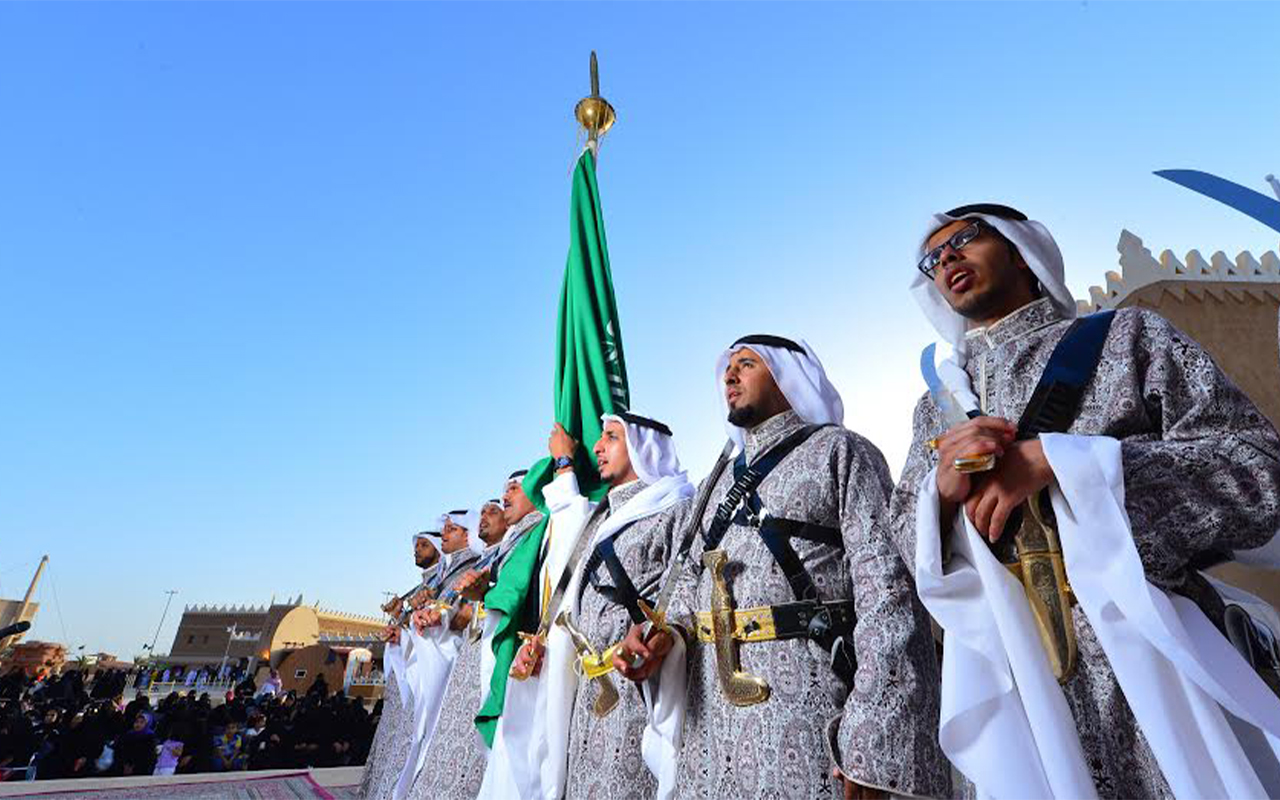
The performance of the Saudi Ardah is never without the presence of its flag, also referred to as al-Bairaq. It is an essential cultural component of Ardah performances, and its design is the same as the Saudi national flag.
The flagbearer, who is referred to as Hamil al-Bairaq, takes a central position between the two groups in the Ardah: the group of war poem reciters and a group of drummers. The flagbearer stands prominently, occupying the highest position in the Ardah arena.
As per the controls established by the Saudi National Center for Saudi Ardah, the flag should have an appropriate size (with dimensions not less than 120x80 cm). According to the Flag Law and its approved regulations in this regard, the flag must not be old or wrinkled, but in good condition and with a suitable appearance.
It should not touch the ground nor lowered to half-mast. The bearer must be committed to wearing the Ardah attire, physically strong, skilled in performing the Ardah, and quick-witted. The flagpole should be carried on the left side, with the flag placed on the right shoulder. The flagpole is topped by a finial and a spear.
The participants in the Saudi Ardah
The Saudi Ardah poet
The Saudi Ardah is based on poetic verses, thus poets are one of its most important components. They recite their lines to the performers, who then repeat them. In the poet's absence, the Muallim substitutes, delivering the poet's verse to the lines of performers. Among the most famous poets of the Saudi Ardah are Fahid Bin Duhayyim, Abdullah Bin Khamis, Mohammed al-Aouni, and others.
The flagbearer in the Saudi Ardah
Flagbearers in the Saudi Ardah are often those who have inherited the role from their fathers, who themselves carried the flag of unification during their participation in the wars and conquests of King Abdulaziz. Carrying the flag is considered an honor for them and serves as a tribute to their fathers.
Group formations
The Hawrabah
At the beginning of the Ardah, also known as al-Bayshna, one of the chanters raises his voice with two or three verses of light war poetry. The others gather around him and raise their voices with the same verses, lifting the Muhawreb over their heads. This acts as a signal to start the Ardah, which in ancient times was a declaration to commence war.
Al-Deir
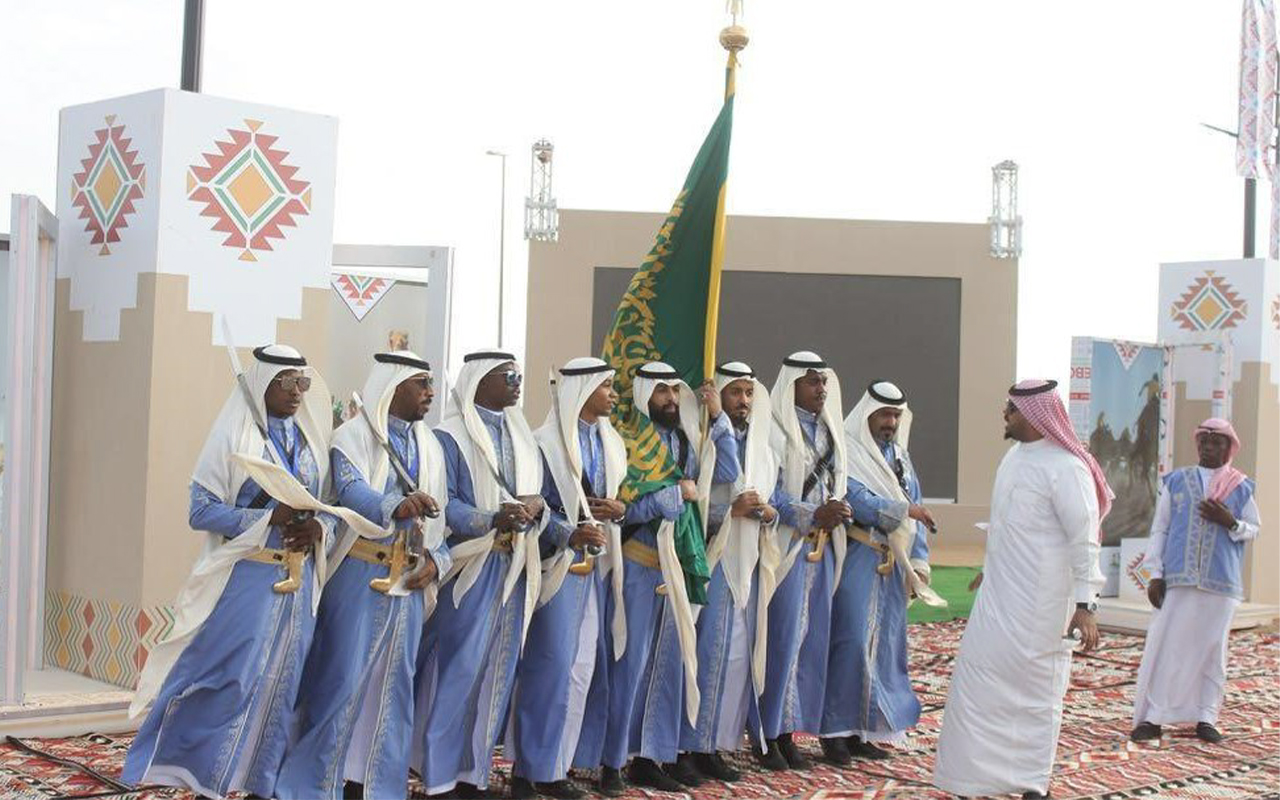
In formal performances, the Ardah takes the form of a sequence akin to a Masbaha, led by the leader followed by his brothers and sons, all performing a single movement, also known as al-Sabha.
Al-Khatimah
It occurs at the end of the Ardah, where the performers move towards the leader, raising their swords towards him and reciting specific verses that express loyalty and support for him. This is also known as al-Zamiya.
The lines of performers (Sufuf)
Performers are men arranged in two lines or a full circle, holding hands and moving in unison to the rhythm by swaying, bending knees, and maneuvering their swords.
As they echo the leader, one line chants the first half of a poetic verse, and the second line responds with the second half.
The cultural context of the Saudi Ardah
The Ardah in local culture
The Ardah is performed at celebrations, weddings, and national and cultural events, and is featured among other traditional dances at national forums, such as the National Festival for Heritage and Culture (Janadriyah).
The Ardah is performed by two facing lines of men in the arena, each with his sword, except for the flagbearer, accompanied by the rhythm of drums and war chant poems.
Leading the Ardah vocally are the chant of Abdulrahman Bin Safiyan in al-Wadiah War, Ya Habeel Al-Ra'i, renowned for its beginning Nahmad Allah Jat Ala Ma Tamanna, and the chant of Fahid Bin Duhayyim, Hin Hal al-Adat, known for its beginning Najd Shamit.
The Saudi and international Ardah
The Saudi Ardah was inscribed in 2015 as the first Saudi element on the Representative List of the Intangible Cultural Heritage of Saudi Arabia registered with the United Nations Educational, Scientific and Cultural Organization (UNESCO) for World Heritage.
The Saudi Ardah became associated with the presence of the King at the Ardah night ceremony concluding the Janadriyah Festival, which has given it significant status and widespread fame. Most traditional Saudi dances were first performed in a military march or as part of a war chant.
The Ardah, as a cultural heritage, transitioned over the course of Saudi history from the preparations for battlefields to the arenas of national celebrations.
Saudi Arabia's Efforts in Rooting the Art of Saudi Ardah
National Center for Saudi Ardah
Saudi Arabia established the National Center for Saudi Ardah, affiliated with the King Abdulaziz Foundation for Research and Archives (Darah), as an authoritative body for developing and reviving the Saudi Ardah heritage.
The center aims to spread the culture of the Ardah domestically and internationally, train in the performance of the Saudi Ardah, and develop the art of the Ardah in terms of performance and form, while preserving this art's identity and essence.
It also focuses on documenting this art, and finally, supporting those affiliated with this art and organizing its teams, performances, and participation.
The center includes an advisory body from various related governmental entities, including the Ministry of Interior, Ministry of Tourism, Ministry of Education, Ministry of Culture, Ministry of Media, and King Abdulaziz Foundation for Research and Archives (Darah).
King Abdulaziz Foundation for Research and Archives (Darah)
The King Abdulaziz Foundation for Research and Archives (Darah) was established by Royal Decree No. (M/45) in 1972, to serve the history, geography, and intellectual and urban literature of Saudi Arabia in particular, and the Arabian Peninsula and Arab and Islamic countries in general. Its purpose is to collect and classify various historical sources, such as documents and others related to Saudi Arabia.
The Darah also publishes a special cultural magazine that serves its intended purposes. A library has been established, containing materials that aid male and female researchers in the subjects of the Darah’s interest. It has been tasked with documenting research and information related to the royal family, monitoring, and verifying everything published about Saudi Arabia, and correcting any errors that may occur.
The Saudi Ardah, a historical documentary study
It is one of the projects launched by the King Abdulaziz Darah to document the history of Saudi Arabia and perpetuate its intellectual and urban heritage. The project studies the Saudi Ardah from the era of King Abdulaziz to the present day, exploring various oral, manuscript, and pictorial sources. It examines its elements, traditions, poets, and their poems.
Saudi Ardah Costumes, a historical documentary study
It is a project launched by King Abdulaziz Darah to document the history of Saudi Arabia and perpetuate its intellectual and urban heritage. The project investigates the traditional costumes of the performers of the Saudi Ardah, including the dancers, drummers, and leaders of the line of performers. The study includes the design of the costume, its materials, manufacturing, and accessories, along with a historical tracing of the Saudi Ardah Costumes.
Folklore competition
A national competition organized by the Saudi Ministry of Culture, to serve and perpetuate Saudi intangible national heritage, by encouraging the community to revive folkloric traditions through recording video or audio clips.
The competition comprises three categories: folk music, folk dance, and folk tales and legends. A prize of approximately SAR35,000 is allocated for each category and awarded to ten winners in each, with total prizes amounting to over SAR1 million.
This competition aims to revive and introduce folkloric traditions, and to create a database of visual and recorded materials.
The oral history of the Saudi Ardah initiative
It is an initiative launched by the Diriyah Gate Development Authority (DGDA) in 2021, aimed at preserving the historical heritage, reviving the Ardah poems, introducing its poets, and educating the community about this heritage art. This initiative falls under the initiatives for documenting oral history.
Saudi Ardah Exhibition
In 2022, the Ministry of Culture inaugurated the Saudi Ardah Exhibition in Riyadh City at al-Safat Square next to Al-Masmak Palace, celebrating the Ardah as an authentic element of Saudi cultural heritage and highlighting its cultural value and its connection to the national identity.
The exhibition featured a visual presentation of the Heda horse Ardah performed by King Abdulaziz, may Allah have mercy on him, as well as a display showing the evolution of the Saudi flag throughout the history of the Saudi state. It also included a photographic display of the kings of Saudi Arabia performing the Ardah on various occasions, highlighting the garments they wore and the swords they used. One of the exhibition's pavilions is dedicated to the craftsmen of the Ardah, focusing on the costumes used by the performers of the Saudi Ardah.
The inauguration of the exhibition coincides with the launch of the Knights of the Ardah Institute, which aims to teach young people and those interested in learning the art of the Ardah and its principles under the guidance of professional trainers.
Diriyah, home of the Ardah
The DGDA launched the Diriyah, Home of the Ardah initiative in 2019. It is the first initiative of its kind in Saudi Arabia targeting the teaching of traditional Ardah to youngsters aged eight to sixteen years.
The initiative is divided into two paths: The first path includes training courses to teach the art of Saudi Ardah by its most skilled performers. The second path involves awarding the Diriyah, Home of the Ardah Prize, which requires enrollment and attendance in training courses to be eligible for nomination and participation.
The Theatre and Performing Arts Commission at the Ministry of Culture works on regulating all folk dances, including the Saudi Ardah.
Sources
National Center for Saudi Ardah.
Saudi Press Agency.
King Abdulaziz Foundation for Research and Archives. (Darah)
Visit Saudi.