Hima Cultural Area
Hima Cultural Area is an archaeological site in Najran Province in the south of the Kingdom of Saudi Arabia, located in Thar Governorate, approximately 130 km north of the city of Najran. The area is abundant in various archaeological remains and landmarks of human civilizations that recount a history dating back to the seventh millennium BC.
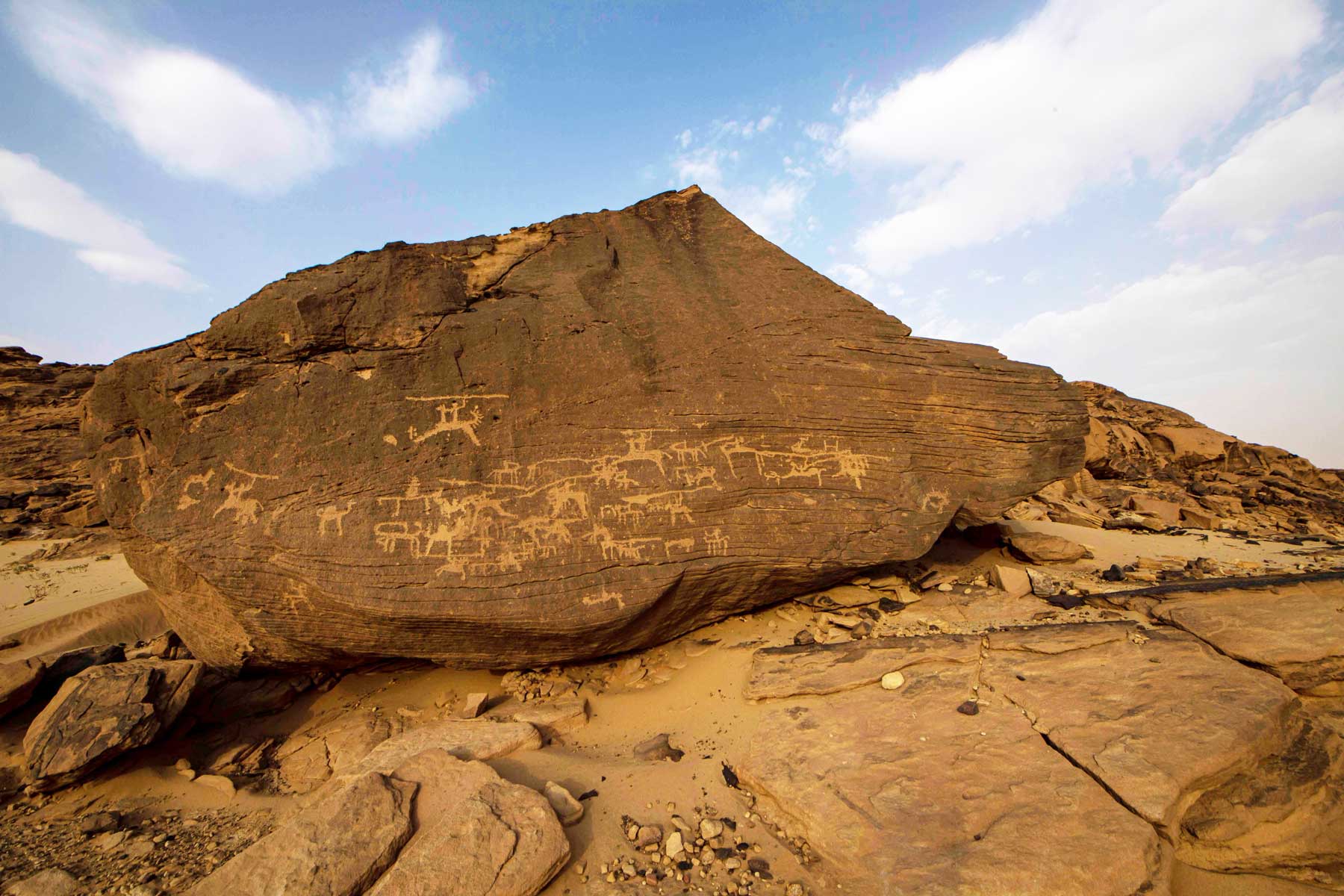
Hima Cultural Area is considered one of the largest rock art complexes globally. The rock art area spans over 557 km², containing around 550 rock art panels featuring hundreds of thousands of inscriptions and rock drawings. Additionally, the Hima site encompasses Hima wells, including Umm Nakhlah, al-Qarayen, al-Janah, Soqya, al-Hamatah, and al-Habisah.
Hima Cultural Area monuments
Hima Area includes several archaeological sites, such as Jabal 'Sidah', Jabal 'Hima', 'Aan Jamal' Site, 'Shis'a', and 'al-Kawkab'. The site also includes the archaeological wells of Hima, including: Umm Nakhlah, al-Qarayen, al-Janah, Soqya, al-Hamatah, and al-Habisah. Most of those wells were excavated in the rocks, and they are considered to be one of the landmarks of civilization and ancient history in the Hima Area. It is surrounded by caves and mountains on all sides except the eastern side, and is full of rock drawings and inscriptions that include human and animal depictions.
The historical importance of the Hima Area
The area surrounding the Hima wells has been a site of human settlement for millennia and is renowned as one of the pivotal stations along the caravan routes spanning from the southern to the northern regions of the Arabian Peninsula, and vice versa. It stands as one of the most significant rock art sites in the Kingdom, boasting over thirteen locations. These sites showcase depictions of hunting and herding scenes, with human figures portrayed larger than life-size, accompanied by inscriptions in Thamudic, Southern Musnad, and Kufic scripts.
The continuous cultural succession in the area has contributed to the production of numerous antiquities and inscriptions across its various sites. It has been possible to identify around one hundred sites that have witnessed cultural movements throughout various periods. Recent archaeological discoveries in the area, made by specialized Saudi and international teams, have revealed civilizations dating back to the Stone Age. One significant achievement was the work of the Saudi-Japanese mission in cooperation with 'JICA' in 2002, which documented approximately ninety inscriptions distributed among sites such as Hima, al-Arissa, al-Khashibah, al-Masmaah, al-Naslaa al-Ulia, al-Kawkab, and other locations in Najran Province
The inscriptions and writings showcased the vitality of the Hima site and its significance as a hub of cultural and human communication across various time periods. One of the most notable inscriptions found at the site is that of King Yusuf Asar Yathar, who documented his victory over the Abyssinians in 518. The site also comprises a collection of ancient wells that served as a station for trade caravans. The inscriptions often depict scenes of battle or hunting, predominantly featuring spears adorned with decorations in the middle, as well as drawings of shields, bows, and arrows. Additionally, other drawings depict knives and blades, all of which were utilized in hunting or warfare.
Registering Hima Area on the World Heritage List
The World Heritage Committee of the United Nations Educational, Scientific and Cultural Organization 'UNESCO' announced during its forty-fourth session meetings on July 24, 2021, the inscription of the 'Hima Cultural Area' in Najran on the organization’s World Heritage List, recognizing it as a cultural site of exceptional value for human heritage. This marks the sixth Saudi heritage site to be registered on the list, following al-Hijr, al-Turayf neighborhood in historic Diriyah, Historic Jeddah, the rock art sites in Hail, and al-Ahsa Oasis.
Preparing the registration file for the Hima Cultural Area entailed three years of dedicated effort to align with the criteria set by the World Heritage Committee and to effectively demonstrate the "Outstanding Universal Value" of the site. Additionally, ensuring that the site would receive the necessary protection and treatment as a World Heritage site required close collaboration and partnership between the Heritage Commission and local officials. Following the successful listing of the site on the World Heritage List, the Heritage Commission orchestrated a ceremonial event in Hima area. During this event, an introductory presentation highlighting the significant archaeological features of the Hima Cultural Area was delivered to the attendees. This encompassed the exploration of rock art and inscribed stones from various civilizations, particularly those predating the Islamic era. Furthermore, the event showcased traditional heritage dishes originating from Najran Province.
Archaeological sites in Hima Cultural Area
Jabal Saidah
Jabal Saidah is a prominent archaeological and tourist site, its significance rooted in its archaeological inscriptions that it retained across the ages. The mountain boasts a rich historical heritage and serves as a significant tourist destination, drawing visitors from both within the Kingdom and beyond. Tourists flock to admire the ancient drawings and inscriptions carved by humans into the mountain's rocky surfaces, as well as the stone tools employed in crafting these varied and elaborate scriptural depictions. These artifacts reflect the artistic prowess and ingenuity of ancient civilizations
Jabal al-Kawkab
It is among the sites rich in rock art in terms of drawings and writings. Due to the environmental diversity in the area surrounding Jabal al-Kawkab, the subjects engraved on the rocks are varied. The inscriptions on Jabal al-Kawkab serve as a historical record of many caravans that passed through the area, which explains the prevalence of camels and horses in the rock inscriptions. Their dense and repeated presence reflects the interest of the region's inhabitants since ancient times in acquiring and caring for these animals, boasting about them in their drawings and artistic subjects, indicating that they held an important place in their social and economic lives. The inscriptions also reveal the ancient artist's diverse skills, culture, and broad perception through the variety of artistic styles and social themes. They showed the presence of predatory animals during that period, such as lions, with drawings found in various places on the rock facades.
Error 429 Too many requests
Too many requests
Error 54113
Details: cache-cmh1290069-CMH 1792753627 3643878496
Varnish cache server
Error 429 Too many requests
Too many requests
Error 54113
Details: cache-cmh1290069-CMH 1792753627 3643878496
Varnish cache server
Error 429 Too many requests
Too many requests
Error 54113
Details: cache-cmh1290069-CMH 1792753627 3643878496
Varnish cache server
Error 429 Too many requests
Too many requests
Error 54113
Details: cache-cmh1290069-CMH 1792753627 3643878496
Varnish cache server
Error 429 Too many requests
Too many requests
Error 54113
Details: cache-cmh1290069-CMH 1792753627 3643878496
Varnish cache server
Error 429 Too many requests
Too many requests
Error 54113
Details: cache-cmh1290069-CMH 1792753627 3643878496
Varnish cache server
Error 429 Too many requests
Too many requests
Error 54113
Details: cache-cmh1290069-CMH 1792753627 3643878496
Varnish cache server
Error 429 Too many requests
Too many requests
Error 54113
Details: cache-cmh1290069-CMH 1792753627 3643878496
Varnish cache server
Error 429 Too many requests
Too many requests
Error 54113
Details: cache-cmh1290069-CMH 1792753627 3643878496
Varnish cache server
Error 429 Too many requests
Too many requests
Error 54113
Details: cache-cmh1290069-CMH 1792753627 3643878496
Varnish cache server
Error 429 Too many requests
Too many requests
Error 54113
Details: cache-cmh1290069-CMH 1792753627 3643878496
Varnish cache server
Error 429 Too many requests
Too many requests
Error 54113
Details: cache-cmh1290069-CMH 1792753627 3643878496
Varnish cache server
Error 429 Too many requests
Too many requests
Error 54113
Details: cache-cmh1290069-CMH 1792753627 3643878496
Varnish cache server
Error 429 Too many requests
Too many requests
Error 54113
Details: cache-cmh1290069-CMH 1792753627 3643878496
Varnish cache server
Error 429 Too many requests
Too many requests
Error 54113
Details: cache-cmh1290069-CMH 1792753627 3643878496
Varnish cache server
Error 429 Too many requests
Too many requests
Error 54113
Details: cache-cmh1290069-CMH 1792753627 3643878496
Varnish cache server
Error 429 Too many requests
Too many requests
Error 54113
Details: cache-cmh1290069-CMH 1792753627 3643878496
Varnish cache server
Error 429 Too many requests
Too many requests
Error 54113
Details: cache-cmh1290069-CMH 1792753627 3643878496
Varnish cache server
Sources
Saudi Press Agency.
Encyclopedia of archaeological evidence on the routes of ancient caravan routes in the Arabian Peninsula. Abdullah Bin Mohammed al-Shaya. King Abdulaziz Foundation for Research and Archives (Darah). 2009.