Agriculture in Saudi Arabia
Agriculture in the Kingdom of Saudi Arabia is considered one of the pillars of the national economy in the Kingdom. The total cultivated area in the Kingdom for 2017 was approximately one million ha. Although agricultural activity takes place in all regions of the Kingdom, they are particularly concentrated in the Riyadh, Qassim, Hail, and al-Jawf provinces.
Agriculture in the Kingdom generally relies on groundwater. Therefore, the National Water Strategy aims to reduce reliance on non-renewable groundwater for agriculture from nineteen billion m³ in 2017 to 6.2 billion m³ by 2030. The strategy also focuses on developing renewable water sources, such as rainwater harvesting and the reuse of treated wastewater.
A historical overview of agriculture in Saudi Arabia
Ancient agricultural methods in Saudi Arabia
Agriculture is one of the professions that has been associated with humans since ancient times. In the Kingdom, farmers used traditional methods for cultivating the land. In terms of extracting water from wells or in terms of plowing or harvesting, they also used the plow, which is a very ancient tool.
The plowing process for each agricultural crop began when farmers observed the appearance of stars. Before commencing plowing, farmers ensured to enrich the soil with natural or synthetic fertilizers. They utilized various assisting tools for plowing, such as the plow, harrow, spade, and rake.
To level the land and cover the seeds after plowing, ancient farmers used a tool called Midsam, a wide wooden plank about two m long, dragged over the plowed land by oxen or camels.
Agriculture in Saudi Arabia in recent times
The agriculture sector in the Kingdom has undergone various developments and stages, including land reclamation, cultivating suitable crops according to agricultural seasons, expanding land cultivation with the assistance of farmers, and providing them with agricultural loans. This comes in addition to implementation of the programs of Saudi Vision 2030, the adoption of the National Environment Strategy, the National Water Strategy, and the Food Security Strategy, and the adoption of programs and studies related to the agricultural sector. Noteworthy among these are the Agricultural Subsidies Program to redirect agricultural support to eligible recipients and the Sustainable Agricultural Rural Development Program, known as 'Reef.'
Agriculture seasons in Saudi Arabia
According to the agricultural census methodology organized by the General Authority for Statistics, there are two agricultural seasons:
The winter season, during which winter crops are planted, has a production cycle of less than a year. These crops are typically sown from November to the end of December and harvested in March each year, either in open fields or under permanent crops like fruit trees. Some of the prominent winter crops include onions, garlic, carrots, peas, and cauliflower.
The summer season, during which summer crops are planted, has a production cycle of less than a year. Summer crops are usually sown in March, April, and May and are harvested during August and September each year, whether in open fields or under permanent crops like fruit trees. Prominent summer crops include watermelon, cantaloupe, tomatoes, cucumbers, and eggplant.
Error 429 Too many requests
Too many requests
Error 54113
Details: cache-cmh1290052-CMH 1792888048 2460684743
Varnish cache server
Agriculture in Saudi Arabia Provinces
Agriculture in Riyadh Province
Error 429 Too many requests
Too many requests
Error 54113
Details: cache-cmh1290052-CMH 1792888048 2460684743
Varnish cache server
Agriculture in al-Ahsa Governorate
Error 429 Too many requests
Too many requests
Error 54113
Details: cache-cmh1290052-CMH 1792888048 2460684743
Varnish cache server
Agriculture in Tabuk Province
Error 429 Too many requests
Too many requests
Error 54113
Details: cache-cmh1290052-CMH 1792888048 2460684743
Varnish cache server
Agriculture in Jazan Province
Error 429 Too many requests
Too many requests
Error 54113
Details: cache-cmh1290052-CMH 1792888048 2460684743
Varnish cache server
Error 429 Too many requests
Too many requests
Error 54113
Details: cache-cmh1290052-CMH 1792888048 2460684743
Varnish cache server
Agriculture in Qassim Province
Error 429 Too many requests
Too many requests
Error 54113
Details: cache-cmh1290052-CMH 1792888048 2460684743
Varnish cache server
Agriculture in Hail Province
Error 429 Too many requests
Too many requests
Error 54113
Details: cache-cmh1290052-CMH 1792888048 2460684743
Varnish cache server
Agriculture in al-Jawf Province
Error 429 Too many requests
Too many requests
Error 54113
Details: cache-cmh1290052-CMH 1792888048 2460684743
Varnish cache server
Agriculture in al-Bahah Province
Error 429 Too many requests
Too many requests
Error 54113
Details: cache-cmh1290052-CMH 1792888048 2460684743
Varnish cache server
Agricultural production of Saudi Arabia
Error 429 Too many requests
Too many requests
Error 54113
Details: cache-cmh1290052-CMH 1792888048 2460684743
Varnish cache server
Seasonal agriculture
Error 429 Too many requests
Too many requests
Error 54113
Details: cache-cmh1290052-CMH 1792888048 2460684743
Varnish cache server
Seasonal agriculture for grain crops in Saudi Arabia
Error 429 Too many requests
Too many requests
Error 54113
Details: cache-cmh1290052-CMH 1792888048 2460684743
Varnish cache server
Seasonal fruit cultivation in Saudi Arabia
Error 429 Too many requests
Too many requests
Error 54113
Details: cache-cmh1290052-CMH 1792888048 2460684743
Varnish cache server
Seasonal palm cultivation in Saudi Arabia
Error 429 Too many requests
Too many requests
Error 54113
Details: cache-cmh1290052-CMH 1792888048 2460684743
Varnish cache server
Error 429 Too many requests
Too many requests
Error 54113
Details: cache-cmh1290052-CMH 1792888048 2460684743
Varnish cache server
Seasonal agriculture of vegetables in Saudi Arabia
Error 429 Too many requests
Too many requests
Error 54113
Details: cache-cmh1290052-CMH 1792888048 2460684743
Varnish cache server
Organic agriculture in Saudi Arabia
This is an environmentally friendly agricultural practice that produces safe food for humans. It relies on an agricultural approach rich in natural materials, avoiding the use of chemical fertilizers, pesticides, hormones, or genetically modified materials. Organic products can be found in major food markets and specialty stores dedicated to selling organic products. The organic products, fresh produce, grains, or canned goods can be identified through the label of the Saudi National Organic Logo 'Organic'. The label is issued by the Organic Production Management for farmers, producers, and manufacturers.
On May 9, 2016, the Saudi Council of Ministers has approved the policy of organic agriculture in the Kingdom. This policy aims to provide safe and environmentally friendly organic plant and animal products, with the goal of producing high-quality, safe food while preserving the environment and natural resources. It also aims to optimize irrigation water consumption, increase the level of organic production, and support organic agricultural production.
Benefits of organic foods for human health
Several research studies have been conducted on organic foods, examining their impact on human health when consumed. Among these studies:
Reduced allergies and weights in a group of children consuming organic foods, compared to another group consuming conventional foods.
A 21 percent increase in human plasma levels and total antioxidant capacity was observed in individuals who consumed organic food products during the experiment.
Reduced risk of eczema and decreased risk of cardiovascular diseases,as well as reducing the risk of developing pre-eclampsia, with a 21 percent reduction in the incidence rate of non-Hodgkin's lymphoma cancer.
Organic agriculture production in Saudi Arabia
According to the Agricultural Statistics Bulletin for 2021 issued by the General Authority for Statistics, the total production of organic agriculture for crops reached approximately 98,774 t. The total area of organic agriculture was 27,109 ha, with a growth rate of 1.8 percent compared to 2020. The area dedicated to the organic cultivation of fruits (excluding dates) was around 13,243 ha, accounting for 48.9 percent of the total organic agriculture area in the Kingdom. Organic cultivation of fruit crops (excluding dates) constituted 63.3 percent of the total organic agriculture production. Meanwhile, the area of organic date palm cultivation accounted for 23.8 percent of the total organic agriculture area in the Kingdom for the same year. The number of cattle in organic agriculture reached approximately six hundred in the Kingdom. Additionally, the number of organic and transitional beehives amounted to 6,500 hives.
The number of organic and transitional farms reached 512, with 225 outlets for selling organic food and a total of 242 organic inputs. Between 2016 and 2022, there was a growth rate of 327 percent in the numbers of organic and transitional holdings, a 142 percent growth rate in the number of outlets selling organic food, and a 166 percent growth rate in the areas of organic agriculture. These statistics are according to data published on the official website of the Saudi Organic Farming Association (SOFA).
World Organic Food Day
On November 1, 2022, the Council of Ministers approved the designation of November 11 of each year as Organic Food Day. The organic agriculture sector in the Kingdom has received attention, support, and development. The Kingdom seeks to become a regional hub for organic agriculture, leading to the establishment of SOFA and the creation of an Organic Production Department at the Ministry of Environment, Water, and Agriculture. The Agricultural Research Center in Qassim has been transformed into a national center for organic farming. This comes in addition to approving the organic farming policy in the Kingdom and adopting an implementation action plan for it, and the presence of Organic Agriculture Law and the Implementing Regulations specific to organic agriculture activities.
The International Organic Trade Fair (Biofach Saudi Arabia)
On November 7, 2022, the Ministry of Environment, Water, and Agriculture inaugurated the International Organic Trade Fair 2022 (Biofach Saudi Arabia) and its accompanying international conference. The event took place at the Riyadh International Convention and Exhibition Center and lasted for three days. This exhibition, the first of its kind in the Gulf region, the Middle East, and North Africa, aims to showcase the role of entities involved in developing and promoting organic agriculture. It also seeks to raise awareness about the importance of organic agriculture and sustainable lifestyles, while presenting local organic products. The second edition of the exhibition will take place from November 19 to 21, 2023, at the Riyadh International Convention and Exhibition Center, and will last for three days.
The international fair is one of the largest fairs dedicated to marketing and promoting investment in organic products. It has been held in seven countries: the United States, Brazil, Thailand, India, China, Japan, and Germany.
Cultivation of aromatic plants in Saudi Arabia
The cultivation of aromatic plants is widespread in the south of the Kingdom, with a concentrated presence in Jazan Province, where there are more than 950 farms producing Jasminum sambac from aromatic plants. These products are exported to the markets, and among the varieties are jasmine, pandanus tectorius, artemisia, narcissus, and ruta, khuturlavender, Wormwood, shikband ochthochloa. Widely used, aromatic plants are employed in local communities for personal adornment and enhancing the ambiance of spaces. Additionally, they are utilized in the production of essential oils as well as in the manufacturing of perfumes, cosmetics, soap, and medicines.
Types of aromatic plants in Saudi Arabia
Several types of aromatic plants are cultivated in the Kingdom, emitting diverse fragrances suitable for decorating city entrances, squares, streets, and yards, as well as planting gardens. These plants include Sorbus, a perennial shrub with leaves that tend to a dusty white color, emitting a scent reminiscent of marjoram in al-Madinah al-Munawwarah, thriving in moderate climates in the Kingdom; 'ruta,' an herbaceous shrub with green, slightly blue leaves and yellow flowers with a potent fragrance, grown in the Sarat, Tihama, and the moderate Red Sea plains; 'artemisia,' an herbaceous plant with bell-shaped purple flowers and a thyme-like aroma, cultivated in moderate to cool, non-hot regions; and 'lavender,' a perennial aromatic plant with a rosemary-like scent and purple flowers, which produces honey when pollinated by bees, it is cultivated in moderate and cool, non-hot areas.
Aromatic plants in Saudi culture
Aromatic plants are a popular heritage passed down through generations, and it is customary in Jazan region for men to wear headbands made of aromatic plants to adorn their heads. These headbands vary in shape, color, and size. As for women, they elegantly wrap aromatic plants around their necks and place them on the hair of the bride to symbolize adornment and joy.
Aromatic plants as economic contributors
Due to the association of aromatic plants with the regional identity, the trade of these aromatic plants thrives in Jazan, Abha, and the city of Taif. They experience high demand during occasions and holidays, serving as economic contributors that yield financial gains. Saudi women in Jazan and Abha run commercial shops where they sell perfumes and incense, utilizing their personal expertise in manufacturing and creating their own blends. Some of them view festivals and weddings as opportunities to sell these aromatic products, while others establish their businesses from home or on social media platforms.
Ways to use essential oils in Saudi Arabia
Aromatic oils serve various purposes, including their use in the cosmetics industry for the production of beauty products, soaps, and perfumes. Additionally, aromatic oils find application in the food industry to enhance flavor or preserve food and beverages. Some aromatic oils are utilized for medicinal or pharmaceutical purposes, such as thyme essential oil, which is used as an anti-inflammatory or antiseptic.
Aromatic oils are extracted from plants using various methods, including extraction with organic solvents, enzymatic hydrolysis, cold pressing, distillation, and extraction through absorption or soaking in fat.
The Association of Jasmine and Aromatic Plants
In 2022, the Association of Jasmine and Aromatic Plants was established. The association is authorized by the Ministry of Human Resources and Social Development, with the aim of supporting jasmine and aromatic plant farmers. Its goals include the development and enhancement of their products, addressing the challenges they face, and providing agricultural materials, such as seedlings, seeds, fertilizers, agricultural equipment, and insecticides. The association also focuses on the improvement and qualification of farms, ensuring they obtain the necessary certifications for exporting products. Additionally, it organizes marketing and agricultural festivals for jasmine and aromatic plants.
Rose cultivation in Saudi Arabia
Rose cultivation in Taif
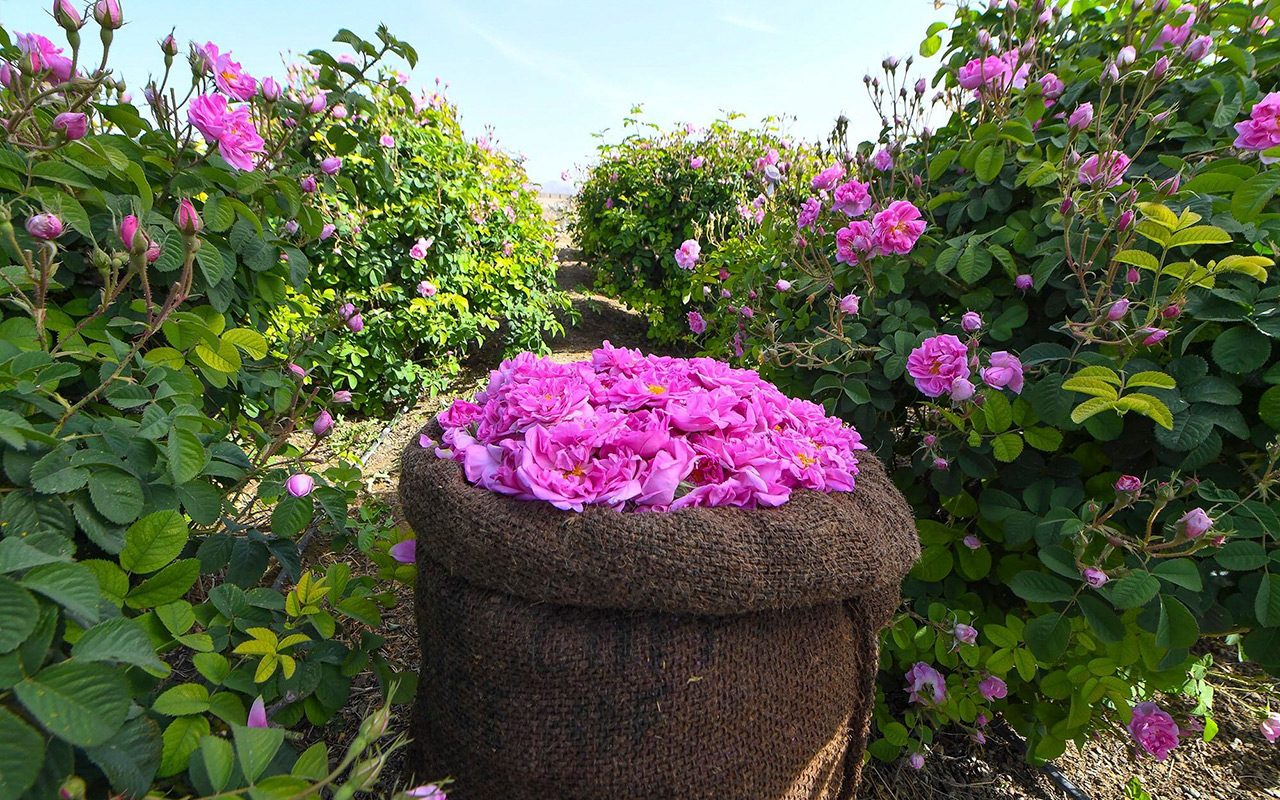
Taif City is known for rose cultivation, specializing in two types. The first is the Taif rose, characterized by its light red color and distinctive fragrance. The second is the deep red rose. Its cultivation is concentrated in elevated areas within the province, including al-Shafa, al-Huda, Wadi al-Aamak, Wadi al-Bani, Wadi Mahram, in addition to the provinces of Tuwairiq and al-Makhadhah.
Rose cultivation begins in December, which is a suitable time for plowing, fertilizing, and watering rose fields. In mid-January,when temperatures in the province drop to around five degrees Celsius, the process of trimming the rose bushes begins in preparation for the blooming season in spring. By the end of March, the rose-picking season starts, lasting between thirty-five to forty-five days, with an average farm production of around seventy thousand roses per day.
Rose cultivation in al-Madinah al-Munawwarah
The Madini rose tree is planted at the end of the winter season. It is a perennial tree that reproduces through suckers or layering in the soil or air layering. Flowering begins approximately six months after planting, and the production of the tree increases as it grows older. After two years of cultivation, the tree undergoes a pruning process, where the tall stems are cut back to about half a m. This pruning results in the emergence of more buds and stems each year, contributing to increased vegetative growth of the tree. The Madini rose is used in the production of various high-quality perfumes. Raw rose oil and rose water, which are used in cosmetics and beauty products, are extracted from it.
Rose cultivation in Tabuk
'Astra Farms' takes the lead in rose cultivation in Tabuk Province and has been at the forefront in the field of picked flowers since it established the 'Astra Flowers' brand in 1983. The farms implement modern techniques in the cultivation, care, sorting, packaging, and wrapping of picked flowers. In 2018, the cultivated area of Astra Farms exceeded 3,300 ha. Annually, the farms produce more than thirty-three million flowers of various types and colors. Approximately 20 percent of the annual production is exported to countries, such as Germany, the Netherlands, the Czech Republic, the United Kingdom, Cyprus, Lebanon, and Gulf Arab countries, in addition to nations in Asia and Latin America.
Astra Farms' flower range includes various types of Gypsophila, such as Million Stars, Perfect, and Brill's Blossom, averaging between eight hundred to one thousand g in weight. They also offer a diverse array of carnation colors like red, white, pink, yellow, orange, lilac, violet, and different varieties of Damask rose, including red, white, pink, yellow, purple, orange, and bi-colored. Notably, 'Avalanche' stands out as a prominent white rose variety, renowned as one of the best types of white roses globally.
It also produces various rose varieties, including Magic Red, Black Magic, Angelina, and Prestige, which are among the red rose varieties. Additionally, it cultivates Meliva roses, one of the most renowned orange rose varieties, as well as Chronos and Ducat from the yellow rose varieties. Revival represents one of the pink rose varieties, while Deep Water belongs to the purple rose varieties. Gerbera flowers are cultivated in a diverse range of colors, such as white, red, yellow, pink, and purple, throughout the year using highly advanced shading systems. White Zembla is the main type of rose produced in Astra, and Lily flowers are also grown in various collections, including Astatiq, Longi Astatiq in different colors, such as white, red, pink, orange, and yellow, Floraam in white, Oriental Lily in white, pink, and red, as well as other types like Gerbera, Alstroemeria, Liatris, and Lisianthus in various colors of red, white, pink, and yellow.
Taif rose in the Guinness Book of Records
In 2022, the Kingdom achieved a Guinness World Record through the local cultivation of roses. This record was set by the creation of the 'Taif Rose Basket,' which is recyclable. It was produced during the annual Taif Rose Festival organized by the Saudi Ministry of Culture. This accomplishment surpassed the previous record set by the Singaporean Rose Basket in 2018. More than 190 young men and women from Taif worked on the basket for over 168 hours.
The basket included twenty-six varieties of the finest roses, arranged in a bouquet consisting of 84,450 flowers. Materials such as wood, cork, iron, and plastic were used in the manufacturing of the basket. The basket measured approximately 12.129 m in length, 7.98 m in width, and 1.297 m in height. The Singaporean basket had dimensions of 9.47 m in length, six m in width, and a height of 1.2 m.
Agricultural technologies in Saudi Arabia
They are the tools and technological methods used in the field of agriculture, varying between relying on animal or mineral resources.
Hydroponic technology
One of the most widely used agricultural technologies is a system that relies on growing plants without soil, using mediums like rock wool and nutrient solutions. This method requires several key elements: automated control for cooling, heating, and ventilation; automated units for irrigation and fertilization; a sterilization system for reusing and recycling water; and an automated control system for all subsystems within the greenhouse.
Vertical agriculture
It is an intensive agricultural technique that utilizes plastic pipes or multi-level tables to make the most of the available space and increase production. When using this technique, several requirements must be met, including control of cooling, heating, and ventilation, automated units for irrigation and fertilization, water recirculation and reuse disinfection system, an automated control system for all subsystems within the greenhouse, and insulating walls for the ceiling and sides.
Aquaponic technology or integrative agriculture
Aquaponics is a closed-loop integrated system combining plant nutrition with fish waste. It involves the co-cultivation of plants and fish and requires several key elements for its operation: control over cooling, heating, and ventilation; an irrigation and fertilization system. Additionally, it requires automated units for irrigation and fertilization, an oxygenation and circulation system, a sterilization system for treating and reusing water, and an automated control system to manage all these systems within a protected environment like a greenhouse.
Smart applications related to agriculture in Saudi Arabia
Application of the Ministry of Environment, Water and Agriculture 'Naama'
The 'Naama' portalis the unified electronic services gateway for the Ministry of Environment, Water, and Agriculture system in the Kingdom. It provides beneficiaries with all electronic services across various sectors of the ministry (including environment, water, agriculture, animal wealth, land, and fisheries). The portal has a mobile application developed in 2019, available in three app stores for Google, Apple, and Huawei for electronic applications. The application allows users to access 291 electronic services related to the Ministry of Environment, Water, and Agriculture. These services are divided into nine main categories, such as license services like requesting a well drilling permit, issuing a contractor activity license, updating a contractor's well drilling license, requesting the export of vegetable crops, licensing veterinary profession, requesting import licenses for vegetables and fruits, requesting the licensing for beekeeping and honey production, requesting the cancellation of beekeeping permits, requesting operational licensing for plant wealth projects, requesting the conversion of a paper license to an electronic one for plant wealth projects, requesting the renewal of construction or operational licenses for marketing services, and requesting preliminary permits for veterinary establishment licensing.
The 'Naama' application encompasses various services related to export, import, and customs clearance. This includes requests for importing fertilizers and agricultural enhancers, seeds and plant seedlings, and agricultural pesticides, as well as requests for exporting fertilizers and agricultural enhancers. Additionally, the app facilitates import permissions for rabbits, rodents, eggs/chicks, livestock, cats, live birds, animal waste, equine semen, and wildlife. It also manages permissions for exporting veterinary devices, aquatic organisms, and items for scientific and research purposes.
In addition to a range of other services, such as general services, animal services, agricultural services, financial support services, environmental services, and water services, in addition to the Asil service dedicated to horses. This service includes the issuance of new and replacement horse passports, ownership transfer of horses, importation of purebred Arabian horses, exportation of purebred Arabian horses, reporting horse births, and printing horse registration certificates.
Agricultural Development Fund Application
It is a government electronic application in the Kingdom, available on both Google and Apple application stores. Established in 2019, the app allows users to access electronic services related to the Agricultural Development Fund. These services include applying for a loan to finance the expenses of an agricultural project, release services and a statement of dealings, whether the request is directed to the Ministry of Justice or other government entities. The app also provides a service to verify the validity of the release and statement of dealings. Additionally, it offers features such as scheduling appointments to meet with Fund officials at the main center or branches. On the communication front, the app includes a remote consultation service that enables clients and citizens to remotely review transactions and communicate with Agricultural Development Fund specialists. Furthermore, the app provides a communication service with the office of the General Manager, specifically designed for sending electronic complaints to the General Manager. There is also a 'Contact Us' service for submitting inquiries, complaints, and suggestions.
The Agricultural Development Fund application includes a service for issuing certificates for agricultural equipment export and a service for requesting an exemption from agricultural loans, enabling the relatives of the deceased to apply for an exemption on behalf of the deceased.
Murshiduk App
This is a government electronic application in the Kingdom, available on both Google and Apple app stores, established in 2019. It enables beneficiaries to connect with over four hundred agricultural advisors in all agricultural specialties. The app offers several advisory services related to agriculture, such as linking with the National Center for Meteorology, managing agricultural advisors, evaluating them, requesting consultations, viewing central markets via live streaming and showcasing their products, inquiring about plants or pests, intelligent identification of pests and diseases in coffee trees, conducting agricultural analyses, and obtaining analysis results through the app without the need for farmers to revisit the center. Additionally, it facilitates communication with an automated guide responsible for answering questions.
Agricultural tourism in Saudi Arabia
Agrotourism is one of the aspects of tourist attraction, where tourists can visit farms, enjoy agricultural activities and rural life, and learn about plant and organic agriculture for the purposes of entertainment and knowledge. In return, agrotourism contributes to the development of farmers and their agricultural products through financing measures, providing employment opportunities for farmers, and fostering tourism and economic growth.
Agricultural tourism in the provinces of Saudi Arabia
In Qassim Province, agricultural tourism is a fundamental pillar of the agricultural economy. It encompasses twenty-one projects for agricultural and rural tourism, including four licensed farms with rural lodgings. More than thirteen annual events related to agricultural products are held, such as the Buraydah Date Festival, Unayzah Date Festival, Grape Festival, Strawberry Festival, Pomegranate Festival, and Pumpkin Festival. Additionally, most of the farms in Qassim have become destinations for locals and those interested in rural tourism during the summer, such as the ancient Sabbakh Farms surrounded by a collection of orchards, Falaeh Unayzah, orchards in al-Midhnab Governorate, and farms in al-Bada'i, al-Khabra, ash-Shimasiyyah, and al-Turufiyyah.
In Makkah al-Mukarramah Province, particularly between the governorates of Jeddah, Khulays, al-Lith, al-Qunfudhah, and Taif, many farmers have invested in their farms, which consist of roses, fruits, and honey. They have transformed them into agricultural tourism projects, developing and preparing them. These farms include a large number of greenhouses of various sizes and open agricultural fields that feature diverse and abundant agricultural varieties throughout the year.
Cooperative Agri-Rural Tourism Association (Refana)
The Cooperative Agri-Rural Tourism Association was established in the Kingdom with the approval of the Ministry of Human Resources and Social Development. The association collaborates with government entities, the private sector, cooperatives, and charitable organizations to promote the culture of agricultural and rural tourism among farmers. It assists them in highlighting the distinctive elements of their farms, establishing rural farms and lodgings, marketing them, and providing job opportunities for young men and women in rural areas while helping in their development.